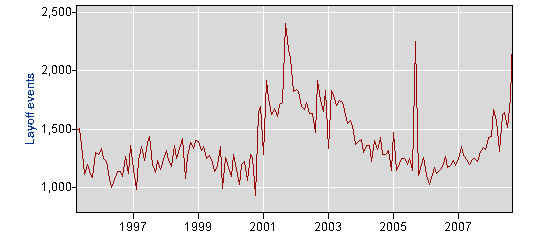
Once again business conditions are difficult and once again companies respond with a hair trigger reaction: employee layoffs. According to the US Labor Statistics, layoffs are approaching peak levels since 1995 —
What happened to that idea that ‘our people are our most important asset?’
There are alternatives to layoffs, however too often corporations, especially large corporations, feel they must appease investors by taking ‘bold’ financial steps. But there are some exceptional exceptions. An article on Salary.com identified some creative alternatives to layoffs.
Company | Strategy |
| 415 Productions | The company offered either an overall 5 percent pay cut, or a four-day work week reflecting the appropriate decrease in pay. |
| Acxiom Corporation | A 5 percent mandatory pay cut, plus an additional 5 percent volunteer pay cut is tempered with increased stock options. |
| Charles Schwab Corp. | The company guaranteed a $7,500 bonus for any affected employee who gets rehired within 18 months. In addition, company founder Charles Schwab and his wife have created a $10 million educational fund for these workers. The fund will cover as much as $20,000 worth of tuition over two years at accredited academic institutions. |
| Texas Instruments | The chip maker began “lending” several human-resources staffers to vendors for as many as eight months, with the intention of bringing them back to their original jobs at the end of that period. The supplier reimburses Texas Instruments for the staffers’ salaries during the loan period and agrees not to offer them a permanent job. |
Then there’s Lincoln Electric in Cleveland, Ohio USA who proudly state —
Guaranteed Employment after three years of service. The company has not exercised its layoff options in the U.S. operations since post war 1948…We will distinguish ourselves through an unwavering commitment to our employees and a relentless drive to maximize shareholder value.
And they delivered, Lincoln has consistently outperformed the S&P 500 over the past 5 years.
I had repeated personal encounters with layoffs when I worked at AT&T. In the 1990s, there were repeated massive layoffs at AT&T. I was given a unique opportunity to work with a small team whose mission was to develop an alternative to layoffs. We developed a proposal for an internal contingent employment unit. Instead of using outside contactors and temps, we would give these assignments to our employees who faced losing their jobs. When I left AT&T in 1998, the unit called “Resource Link” had over 2000 employees.
Finally, Challenger, Gray & Christmas, the noted authority on layoffs, has a worthy blog that offers advice to both employees and employers.