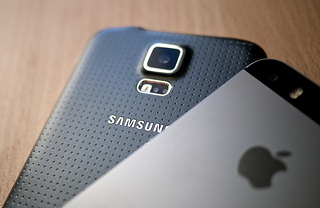
 There was big news in mobile advertising this week, and it’s a sign of a significant shift that brand marketers need to know about. For the first time, Google’s Android surpassed Apple’s iOS and took the top spot for mobile ad traffic for the first quarter of 2014. The data comes from Opera Mediaworks’ Q1 2014 State of Mobile Advertising report.
Not only did Google steal the number one global mobile ad traffic position from Apple with 42.8% of mobile ad traffic compared to 38.2% for Apple, but it also had big gains in year-over-year monetization. At the end of the first quarter of 2014, Android accounted for over 33% of mobile ad revenue, which is a 24% increase over its 26.7% of mobile ad revenue at the same time in 2013.
Focusing on just the U.K. market, Apple’s iOS still holds the top spot with 55% of ad impressions and 66.9% of ad revenue. This isn’t surprising considering Apple’s dominant market share position with 62.3% of unique U.K. users tracked by Opera Mediaworks having iOS devices compared to just 18.6% for Android and 14% for BlackBerry.
The report also offers some statistics related to U.K. mobile users’ preferences and behaviors. For example, U.K. mobile users prefer mobile apps, not mobile websites. Opera Mediaworks determined this based on ad impressions, with mobile apps accounting for 72% of ad impressions in the U.K. market, which is significantly higher than what was found in the global market (31%). Furthermore, U.K. mobile users aren’t afraid to click on mobile video ads. In fact, mobile video ads account for one in seven mobile ads in the U.K., which is much higher than the one in 40 ratio identified globally. As a result, click-through rates on rich-media ads are nearly twice the click-through rates on banner ads in the U.K.
Google’s Android has been the dominant platform for some time now, but app developers and advertisers continued to put their time and money into Apple’s iOS. It’s easier from a development standpoint to develop for Apple’s standard operating system than it is to develop for Google’s operating system that can differ from one device and one manufacturer to another. However, ad traffic and ad revenue statistics are showing that there is a shift happening, and ignoring or de-prioritizing Google’s Android is not a good strategy anymore.
What do you think? Is your brand focused primarily on Apple iOS or does your marketing strategy give Apple iOS and Google Android equal attention? Leave a comment and share your thoughts on the mobile shift and what it means to brand marketers.
Image: Karlis Dambrans