Skittles launched a new version of its website that Carole Walker, Skittles vice president of integrated marketing communications calls, “zany,” but just about everyone else calls plain crazy.
What’s the buzz about? Rather than providing a traditional website that a consumer would expect to find after typing www.skittles.com into their browser search bar, consumers find this…
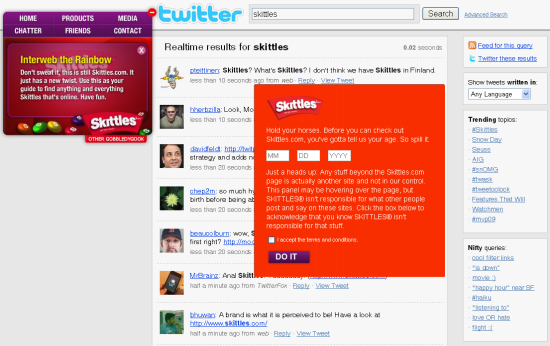
What the heck is that, you ask? Well, you’re not the only one.
If the goal was to stir up a negative online buzz, then the Skittles marketing team succeeded. If the goal was to meet customer expectations (or exceed them), as every brand’s goal should be, then the Skittles team failed.
You see, the Skittles team is trying to bring interactivity to its website by basically replacing the site with either a Twitter page (like the above version) or a Facebook page or even a Wikipedia page to which visitors can add content.
So what do you think? Clever, useful and whimsical as the Skittles team seems to think – or not? I vote not.
When a consumer visits your website, they’re looking for information. They don’t have time to weed through a bunch of cr*p to get to the information they want or need. Bottom-line, when your website causes consumers to stop and say, “What the h*ll is this?” it’s not a good thing. I’m all for adding interactivity to websites and allowing consumers to take control thereby deepening their relationships with a brand, but from the consumer perspective, my feeling is – give me the information I need, and give it to me now, or I’m going to look elsewhere.
My opinion, go back to the drawing board, Skittles.
Your opinion?