
 Marketers can learn a lot from celebrities and the PR machines behind them. As crazy as it might seem, take some time over the next week to listen to celebrity gossip on television and read about it online. Celebrities work hard to keep their names in the spotlight, drumming up positive publicity and putting out the fires of negative publicity. [Read more…] about Five Things Marketers Can Learn from Celebrity Branding
Creating a Relationship Brand
What is a relationship brand? In simplest terms, a relationship brand is one that holds widespread appeal among consumers but still allows each individual consumer to experience the brand in his or her own unique way. Relationship brands have an inherent sense of belonging attached to them. In other words, each customer experiences the brand individually but at the same time, likes knowing he or she is part of a larger group who experiences the brand together.
Creating a relationship brand doesn’t happen overnight. For example, look at a brand like Mac from Apple. Actually, Apple, itself, is a great example of a relationship brand, but let’s just look at Mac right now. While still far behind the PC in terms of market share, the Mac has grown significantly in recent years as the marketing team behind the brand realized the value in the relationship customers have with the brand and with each other as part of a group experiencing the brand together. [Read more…] about Creating a Relationship Brand
What is Employer Branding?
The concept of branding for products and services is well known. Employer branding may be the least known type of branding yet is becoming more important to organizations. The reason is changes in workforce demographics. The baby-boomers are retiring and the pool of new recruits is not sufficient to fill the gap. According to an Accenture survey, 60% of CEOs are very concerned about attracting and retaining people. Enter the concept of Employer Branding.
Brett Minchington (The Employer Brand Institute), defines employer branding as “the image of the organization as a ‘great place to work’ in the minds of current employees and key stakeholders in the external market (active and passive candidates, clients, customers and other key stakeholders).”
UK based Business Development Practice Ltd. indicates that ideally, the central idea behind the employer and client brands should be the same. At the very least they need to be consistent (see above graphic). But unlike product or corporate brands, an employer brand is not as visible to its target audience.
This looks like this subject is starting to get complex and involved. It could, and companies could wind up spending lots of money and time to develop their Employer brand. I have a suggestion: you may have seen Fortune magazine’s annual “Best Companies To Work For”. The organization that does the analysis behind the selection process is The Great Place To Work Institute. If you make it to this list you have an effective Employer Brand.
The companies on this list realize that it is the intellectual capital, what is in the minds and hearts of people – rather than the buildings, the tools, the financial capital – that has the power to truly differentiate and grow a business – and beat the competition. Therefore, they do what is needed to attract, grow and keep their people. Benchmarking how these got to the list makes sense.
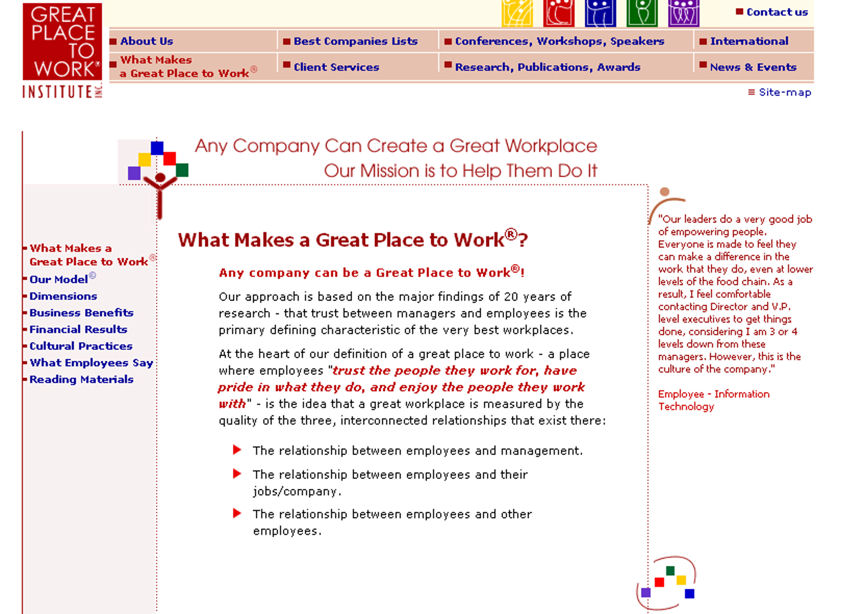
Some suggestions: first look at “Our Model” section. This shows the major dimensions that need to be addressed:
“Trust is the essential ingredient for the primary workplace relationship between the employee and the employer. According to our model, trust is composed of three dimensions: Credibility, Respect, and Fairness. The final two dimensions of the Institute’s model relate to workplace relationships between employees and their jobs/company (Pride), and between the employee and other employees (Camaraderie)”.
This is not quantum physics. It is very straight-forward and not difficult to grasp. Yet too many companies waste money looking for something more esoteric. I particularly like that the Institute says as companies become effective in applying these dimensions the distinction between labour and management fades.
There is more. By treating people well, the companies on the list reap business and financial benefits superior to their peers.
Want to develop an effective Employer Brand? Your first step must be a visit to the The Great Place To Work Institute website.
Thinking About Thought Leadership
It all started with consulting companies, then moved to software/technology companies and now is spreading to all types of companies. Thought leadership, simply put, is giving away content. This could be developed from what your leaders know, case studies or the musings of gurus and subject matter experts you hire.
Why do this? It drives traffic to your corporate website and enhances your company’s reputation as one that buyers may want to do business with. Think of thought leadership as stealth advertising and promotion. The content may not, and some say should not, mention your company. But the association is still made and by sharing your knowledge you build credibility.
[Read more…] about Thinking About Thought Leadership
A Sweetbox of Integrated Sustainability
Can I can I can I can I can I? The refrain of pester power, through which children have “persuaded” their parents into a course of action for millennia.
Often parents agree simply to get the little angels to belt up. Often the little devils come to learn that if they repeat it often and loud enough, their wish will come true.
Many companies have assumed the parental role, embarking upon programmes of disclosure simply to simply to get external pressures (including regulators) to belt up and not bother them.
In the meantime sustainability professionals keep repeating the mantra that sustainability has to be embedded into all of a company’s activities, not just bolted on as an afterthought.
[Read more…] about A Sweetbox of Integrated Sustainability
Disney Co. Chooses ESPN Brand Over Disney Brand
In October 2007, I wrote a post on my branding blog, Brandcurve, about the Disney brand strategy. In the post, I referenced a q&a session with Disney (NYSE: DIS) CFO Tom Staggs at the Merrill Lynch 2007 annual Media Fall Preview event where Staggs basically revealed the secret to Disney’s brand strategy – identify strong, popular brands then exploit them around the world.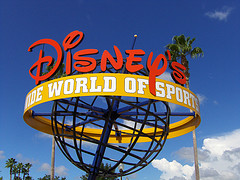
WIth that brand strategy in mind, I was actually surprised to read that Disney is abandoning its brand name on one of its popular properties. According to Brandweek, Disney will remove the Disney brand name from its sports complex at Walt Disney World in Orlando, Florida and replace it with the ESPN brand name. [Read more…] about Disney Co. Chooses ESPN Brand Over Disney Brand