There’s actually a good story about how I came upon today’s topic, but I’m going to save it for another post. (Just remember “Company A.”) For now, I want to zip right on to the silly stuff!
Or let’s put it this way: Given the proposition that recruiting should express a company’s personality—how do you deal with a corporate image that’s quirky, or even downright comical? Should you embrace the humor, play it straight, or go somewhere in between?
(And in case you’re thinking “if only that were my problem,” don’t stop reading. There are some lessons here for seriously dull businesses as well.)
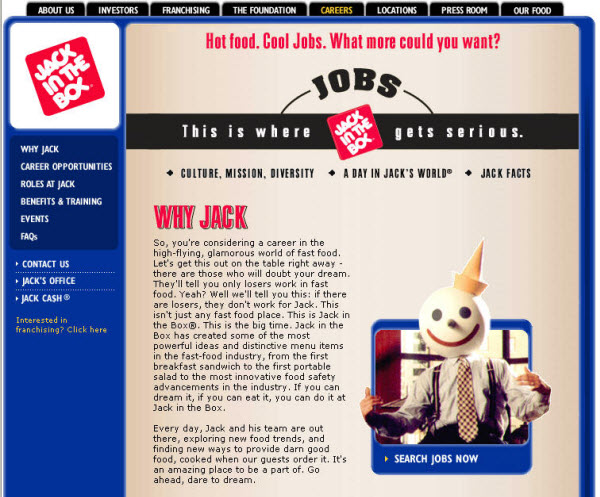
Let’s start by looking at two companies that put a lot of money into making people laugh at their brands. Ask most people for one word about Jack in the Box commercials, and the answer will be “funny.” Same thing for Geico. When job-seekers go to those company sites, they take the humor association right along with them—and it may be a bit of a turn-off if they find an impersonal, unfunny page.
But neither company is recruiting for comic talent, and job-hunting is not by nature a humorous topic. So the key would be to bring the brand together with the mission. Enough Jack, but not too much. Just a touch of Gecko. And the balance needs to fit the business.
For the sake of full disclosure I’d better report at this point that I’m in the tank for Jack. If he’s on TV, I stop to watch, and I never get tired of analyzing the really great Jack moments. (Hint: It’s all about the mouth.) So I’m happy to report that Jack hits the mark on recruiting, with a site that perfectly captures “his” personality through conversational text and iconic illustrations.

Three things to notice: First, attention to detail. For example . . . in some browsers, when you hover on a navigation tab, a Jack antenna-topper pops up above the tab and starts turning his head back and forth. Yes, really! (All across JITB messaging, details sustain the illusion that Jack’s world is an actual place, which is a large part of what makes it all so funny.)
Second, appropriate balance. The “Why Jack” page is LOL funny–I’ve read it about five times now—but it also delivers some solid points. The trick is skillful comic writing that combines tongue-in-cheek delivery (“This is the big time.”) with substantive messaging (“from the first breakfast sandwich to the first portable salad to the most innovative food safety advancements in the industry”).
The “FAQ,” “Benefits,” and “Roles at Jack” pages are written in a crisp, direct style that signals serious business, but each one has a Jack photo, so everything fits together. And notice that every photo on the site neatly fits its page, to reinforce the key message. So Jack’s a high-flying executive on the “Roles” page (read: road to success), but on the “Benefits” page, he’s fly-fishing (read: quality of life).
Finally, the third thing. As they say in show biz, if you want to get around an inconvenient or unlikely plot point, “hang a lantern on it.” So JITB gives the Careers section a special header: Jobs. This is where Jack in the Box gets serious. And that neatly resolves the dissonance problem.
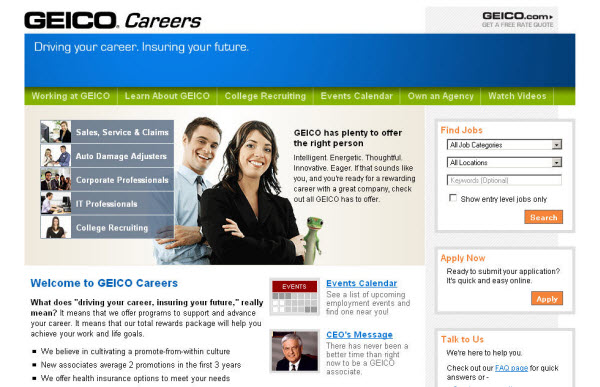
All right—now what about the Gecko? Over at Geico, they have a different set of constraints than JITB, since you just can’t be as playful about car insurance as you can about fast food. So the site itself is stick-straight. But on the landing page—exactly in the very center—there he is. And wouldn’t you have been disappointed otherwise?
Some takeaways for the rest of us:
- Be true to your brand personality.
- Be consistent across pages, but don’t be boring. Use appropriate variety.
- Remember these famous last words, even though no one can remember who said them: “Dying is easy. Comedy–that’s hard.” It may be okay to add a touch of humor to your site, but make sure it works!