
Anyone remember spot the ball competitions? A strange photo of football action had the ball removed and you had to place an X where you thought the ball was. The winner won something, possibly cash.
Talking about business sustainability without mentioning money is a bit like a spot the ball competition. You know it’s there, an essential part of what’s going on, but spotting it can be very difficult indeed.
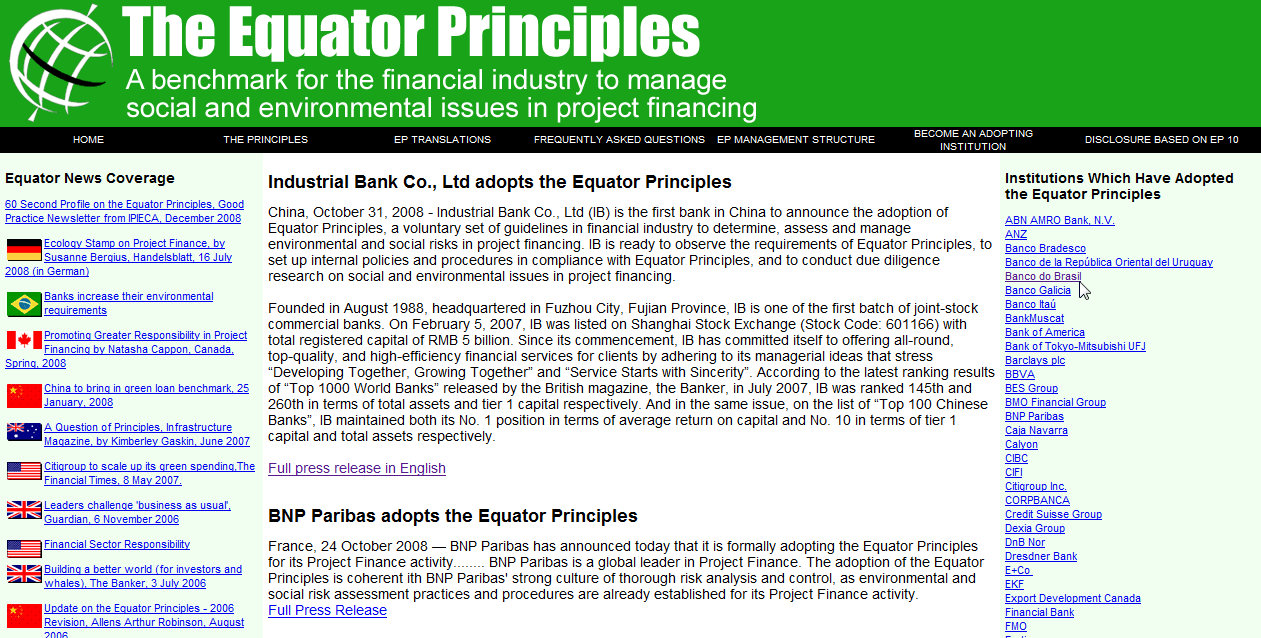
This is where the Equator Principles (EP) come in; a set of benchmarks put together to bring a sense of sustainability to business financing.
Governance of the Principles
The initiative was created in 2003 by the leading banks of the day, including Barclays, Citibank and ABN Amro. It uses the policies of the World Bank and the International Finance Corporation (IFC) as its foundation.
They apply to all projects which financial institutions may engage in with financing of over $10m. This includes both direct lending by the banks and financial consultancy.
In addition, the working groups which govern the principles are not wholly focussed upon the banks. They include representatives of NGOs, Socially Responsible Investment analysts and the banks’ client base.
Inevitably this means that the banks and their clients complain that the principles go too far while the NGOs complain that they don’t go far enough.
This is good and it is heartening to see both sides engaging with one another and feeling able to air their views freely.
The Equator Principles Themselves
There are Ten Principles. Any institution signing up to them commits to ensuring any project it is involved in with a spend of over $10m will conform to these principles.
They are relatively simple and straightforward and define the standards, management systems, consultations and monitoring which the bank should require of the client.
These provide a clear pathway for any institution wishing to improve the sustainability of its activities. These steps are underpinned by policies from the IFC and World Bank which provide the real meat.
For instance, the principles embrace both the IFC’s Eight Performance Standards on Sustainability, ranging from Cultural Heritage to Pollution, and the World Bank’s 41 industry specific Environment, Health and Safety guidelines.
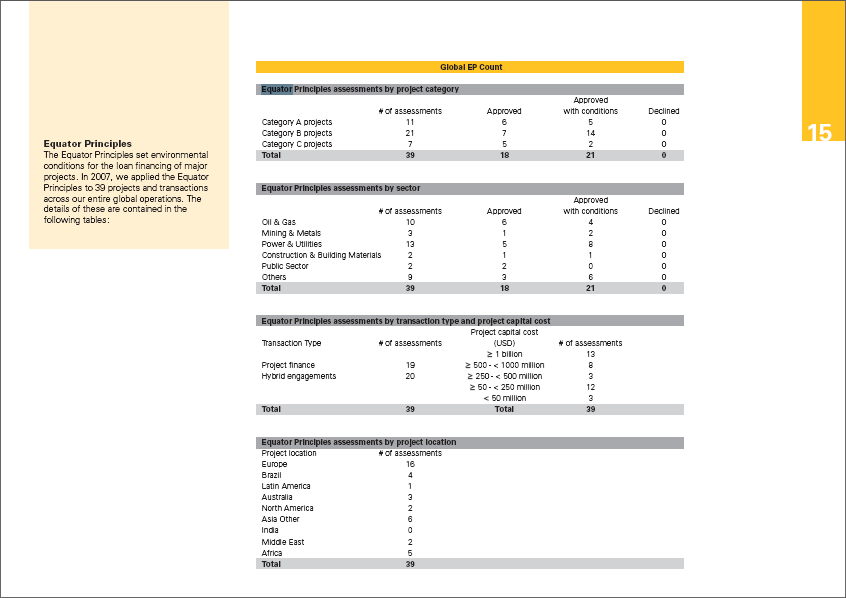 ABN Amro
Equator Principles Figures
Transparency and The Equator Principles
When the EP was first launched there was one major criticism which was levelled at it: transparency. Much like the UN Global Compact, in it had placed more emphasis on signing up institutions than on monitoring their commitment.
To try and rectify this, the principles were updated in 2006 to include a tenth principle to which requires institutions to report at least once a year upon their activities under the principles.
As a minimum this requires banks to report the number of projects they have been involved in. The associated guidance notes encourage institutions to break the information down further, for instance by country or sector.
Detailed figures, such as those provided by ABN Amro, give a tiny glimpse into which projects a bank has been involved in. However this should be only the start if the banks’ disclosures.
For example: what about the bank’s governance? Is the EP included as a standard part of staff training, as appropriate? How will a bank monitor EP compliance and how will it censure a client if they fall out of compliance?
The Equator Principles Should Lead Finance Sustainability
There is no doubt that the EP acts as a force for good within the banking industry.
In the past year its membership has grown by nearly 20%, includes a quarter of the top investment banks in the world and has recently embraced Industrial Bank Co, one of the largest banks in China.
However, having a ball is only the first part of a good game of football. The rest of the sport is made up of robust rules and regulations to ensure one side or another isn’t unduly favoured.
If the quality of the benchmark’s disclosure requirements isn’t improved the EP could encourage accusations of being a vehicle for greenwashers.
This would be a shame because finance is undoubtedly modern society’s main driver. As such the EP should be a leader, not a follower, in ensuring a sustainable economy is built.