
- Thinking Socially: Convincing the CEOI invited Gregory Shumchenia of Modern Pigeon to write a guest post for us – do take a moment to visit his site. Greg started out five years ago as a photographer and just began offering marketing and social media services. He loves the outdoors and will never eat canned tuna. Over to you… 7 […]


- 2 out of 3 Americans Use Social Networking SitesNew statistics from eMarketer reveal that in 2011, 63.7% of American Internet users (147.8 million people) are using social networking sites like Facebook and LinkedIn. By 2012, that number will increase to 66% and by 2013, it will hit 67%. According to these statistics, the days of double-digit user growth for social networking appear to […]
- Brands Launch Tablet Optimized WebsitesThe current hot gadget is the iPad and other tablets are launching quickly to compete with the iPad. It makes sense that brands would want to revamp their websites so they work well on tablets, but brands like MTV and VH1 are leading a new redesign trend. Instead of simply moving website elements around so […]
- Corporate Eye Summary March 19, 2011Launching a Career in Corporate Communications Today we have a guest post from Lauren Bailey offering advice for college students wanting to get started in corporate comms. Lauren Bailey is a freelance writer and blog junkie, who blogs about online colleges. She especially loves hearing back from her readers. Questions or comments can be sent […]
- Google Breaks Web 2.0 Logo Design Trend with New Chrome LogoOver the past decade, more and more companies have been investing in logo redesigns in order to create logos that seems more modern and digital. The glossy, 3-dimensional redesigns have been called the Web 2.0 logo redesign trend. However, that trend might be coming to an end if a new design for Google’s Chrome brand […]
Thinking Socially: Convincing the CEO
 I invited Gregory Shumchenia of Modern Pigeon to write a guest post for us – do take a moment to visit his site.
Greg started out five years ago as a photographer and just began offering marketing and social media services. He loves the outdoors and will never eat canned tuna.
Over to you…
7 Tips for Convincing Senior Management to Go Social
 Are you working for a company that has yet to embrace social media?
This can be especially painful if you see specific areas in which social media would plug in perfectly to your company’s strategies and goals. The resistance to change may be coming directly from the top, with your CEO, or it may be the head of marketing that can’t see the need for all that Facebooking and Twittering.
Whatever the case, here are 7 tips to help convince the powers that be to start thinking more socially, and a few suggestions on how to implement social media into your company’s existing departments.
Step 1: Show your boss the size and scalability of social media:
With over 500 million users on Facebook and over 300 million on Twitter, companies have an opportunity to reach more people and at a lower cost than ever before. Even LinkedIn, the more “professional” social network, is approaching 100 million members. These numbers can’t be denied. Not only does social media extend a company’s reach, but it also allows for a more targeted message. Geographic location, gender, age, and even movie preferences are all readily available through social networking for your company to utilize and help focus its efforts.
Step 2: Find their friends and business partners:
Without getting too intrusive, look around on a few social networks to find your boss’s friends and colleagues — people he respects. Maybe a bit of peer pressure will help enlighten your boss to the true popularity of social media.
Step 3: Find people talking about your brand or industry:
This is one of the more powerful tools. Show your boss that people are already online and actively discussing your specific brand, or at least your industry. It’s in the best interest of your company to be in a position to participate and hopefully influence that conversation — or at the very least be aware of and monitor it. Getting that kind of customer feedback, at virtually no cost and in real time, is invaluable information your company can use to alter it’s product/service or marketing tactics and ultimately improve the customer experience.
Step 4: Case studies & success stories:
Do a little online research for companies in your market, or close to it, that have had success implementing social media into their business. Keep your eye out for companies like Dell, Starbucks, Zappos, Ford… the list could go on and on. These are some big time companies having unbelievable success with social media — both in terms of increasing overall sales and providing crazy-good customer service.
Step 5: Take a look at your competition:
If your competition is somewhere, your customers probably are too. Do some more research into how your competition is using social media. Are they promoting coupons and discounts through Facebook and Twitter? Are they posting location-based ads using FourSquare and Where? Maybe they’re using Twitter to enhance their customer service system, and save money while doing it. This should be a no-brainer for your boss. Make it clear that without a social media presence, you’re losing these customers to competitors — and they’re using less money than you to get them. Furthermore, convince him or her that this ecosystem of customers is constantly growing and that your company is missing out.
Step 6: Social media is here to stay:
Much like telephone and email, social media is here to stay. It’s not just a fad that stops with Facebook, it’s a new communication tool. Refer back to point number one and how big social media has become — but stay away from any “too big to fail” rhetoric, we all know how that will go over. Just emphasize the fact that community and active engagement are what have been missing from advertising since its inception, but have always been something humans crave, so now that they’ve combined, it’s not likely to change — well, only in a positive direction.
Step 7: Show specifically what social media can do for your company:
This step is a bit of a broad one, and will probably take the most work for you to prepare for. The most important thing is to first look at your company’s existing objectives. Are you looking to increase sales? Reduce public relations costs? Increase customer satisfaction? Determine one or two of these objectives as being a good fit for social media and develop a few basic examples of strategies that work towards accomplishing those objectives. For example, if you’re looking to increase overall sales, one strategy would be to develop existing customers into repeat customers. You might notice this has nothing to do with social media yet. Well, that’s the point. These are things your company is (hopefully) already doing. Now you’ll show your boss how social media can plug into these existing strategies by offering customers a 10% off coupon on Twitter after making their first purchase. Get it? Companies have a tendency to set up social media goals like “get 10,000 Facebook fans in our first year” without focusing on how it actually helps their business’s goals. They might hit that 10,000 mark, but what does that mean? What did it do for them?
Wrap up:
Well, there you have it. Hopefully your business is already using social media, but if they’ve missed the boat, or are currently sinking, I’m hoping these tips will help. How does your company or the one you work for view social media? If they’re not using it, what are their biggest arguments against it? If your company does use it, do you feel like it’s making a difference? Let us know what you think in the comments.
Thanks Greg!
Turn Negative Reviews into Positive Word-of-Mouth Marketing
 The Retail Consumer Report research conducted in January 2011 by Harris Interactive (commissioned by RightNow) revealed some interesting information about online shoppers’ experiences and thoughts. As you might expect, consumers who have bad experiences with online retailers won’t buy from those retailers again, and more and more of those dissatisfied consumers are sharing their negative reviews online.
However, the news isn’t all bad. Businesses have an opportunity to turn those negative reviews into positive word-of-mouth marketing by keeping track of online conversations about their businesses and responding to them.
The Harris Interactive study revealed that 68% of consumers who published a complaint or negative review about an online business on a social networking site or a review site were contacted by the businesses they complained about. 18% of those people were so satisfied with the responses they got from those businesses that they made additional purchases and became loyal customers.
Of course, the best case scenario is that your business only gets glowing reviews online, but when a negative comment about your brand and business makes its way online, respond to it. Reach out to the customer and make the situation right with them. As the Harris Interactive study reports, 33% of consumers who were contacted by businesses about their online complaints turned around and published a positive review about that business and 34% deleted their original negative reviews.
The opportunity to respond to negative reviews and fix problems is wide open. 61% of consumers surveyed by Harris Interactive who did not receive a response from a business about whom they published a negative review said they would be shocked if a retailer responded to a negative complaint or review that they published on the social web. Go ahead and shock them!
Keep in mind, the Harris Interactive study determined that 21% of consumers who had positive shopping experiences with an online retailer recommended that retailer to friends and 13% published positive reviews about that retailer online. The study also reported that nearly 1 out of 3 surveyed consumers conducted their own online research on social networking and review sites while they were shopping online. You need to monitor your online reputation, respond to negativity, and make sure the information consumers find about your brand and business is positive and accurate. Online reviews are extremely important. It’s vital that you know what is being said about your brand and business online, so you can jump into conversations when it’s necessary and show your appreciation when it’s appropriate.
Image: stock.xchng
2 out of 3 Americans Use Social Networking Sites
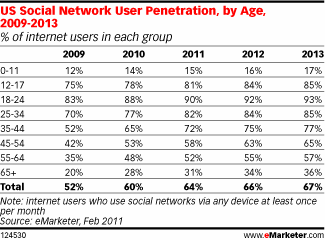 New statistics from eMarketer reveal that in 2011, 63.7% of American Internet users (147.8 million people) are using social networking sites like Facebook and LinkedIn. By 2012, that number will increase to 66% and by 2013, it will hit 67%. According to these statistics, the days of double-digit user growth for social networking appear to be over.
Today, social networking reaches the vast majority of Internet users in the United States, and that number isn’t expected to decline anytime in the near future. That means your customers are using social networking, and your brand needs to be there, too. Of course, the most active users of social networking are still younger generations, but the days of social networking being a fad for young adults and teenagers are long gone. Today, users come from all generations and demographic groups.
In 2011, 90% of Internet users between the ages of 18-24 will use social networks, but older generations continue to become more active in their social networking use. The chart from eMarketer above provides a detailed age breakdown.
Not only do brands need to be present on social networking sites, but they also need to produce interesting and engaging content and conversations that are meaningful to their target audiences. As social networking users become more knowledgeable about the tools they’re using, their demands for useful content and experiences will also grow. If you’re not giving them a good reason to connect with, interact with, and talk about your brand, you won’t achieve the results you need from social networking.
Don’t just create a Facebook page and leave it at that. Instead, talk to your customers and learn what they’d like you to offer on that Facebook page. Create useful applications and content that is both interesting and helpful. You have to find ways to keep your target audience coming back for more.
Again, your customers are using social networks, so if you’re not trying to connect with them on those social networks where they’re already spending time, you’re missing a big opportunity to build relationships with them. If they were standing in front of you would you ignore them? No, you’d try to talk to them and connect with them. You should do the same thing via social networking.
Image: eMarketer
Brands Launch Tablet Optimized Websites
 The current hot gadget is the iPad and other tablets are launching quickly to compete with the iPad. It makes sense that brands would want to revamp their websites so they work well on tablets, but brands like MTV and VH1 are leading a new redesign trend. Instead of simply moving website elements around so they look better on tablets, MTV and VH1 have completely redesigned their websites to take advantage of touch screens, smaller screens, and vibrant screens.
For example, the new MTV and VH1 tablet-optimized websites use less text than their traditional websites. While many brands are simply releasing apps for people to access their web content on smartphones and tablets, MTV and VH1 are betting that some people will want to use apps to access content and others will want to browse the Internet on those devices and consume content in a more traditional way.
The new MTV and VH1 tablet-optimized sites allow anyone with an iPad to view those sites through their tablet web browser function without opening a separate app. For casual visitors, this is a big benefit. While all functions on the full websites aren’t available on the iPad-optimized versions, there is a good variety and one can expect more features are coming.
Currently, the content on the iPad-optimized MTV and VH1 sites are heavy on video, as you might expect from both brands. In other words, the iPad-optimized sites are excellent representations of both brands. Already, Starbucks has signed on for a rich-media ad campaign.
While many companies are focusing on creating tablet apps to deliver their content on iPads and other tablet devices, MTV and VH1 are choosing to cover all their bases and offer great content to all types of visitors. As the tablet user base expands beyond tech-savvy early adopters, this sounds like a wise strategy.
What do you think? Should companies create branded tablet apps as well as tablet-optimized websites, or do you think apps are enough? Leave a comment and share your thoughts on this tablet trend.
Image: Apple.com
Corporate Eye Summary March 19, 2011
- Launching a Career in Corporate CommunicationsToday we have a guest post from Lauren Bailey offering advice for college students wanting to get started in corporate comms. Lauren Bailey is a freelance writer and blog junkie, who blogs about online colleges. She especially loves hearing back from her readers. Questions or comments can be sent to: blauren99 @gmail.com – though we’d […]
- Half of U.K. Population is on FacebookFacebook reports that the social networking site is now used by 1 out of every 2 people in the U.K. As eMarketer reports, 30 million of the 62.6 million people in the U.K. are now on the most popular social networking site in the world, Facebook. That’s up from 25.6 million in September 2010. If […]
- Research Shows How Retail Brand Loyalty Programs Are Failing with ConsumersRetail brand loyalty programs are created to accomplish a primary goal — to encourage repeat purchases that evolve into brand loyalty. Unfortunately, research from ACI Worldwide reports that retail brand loyalty programs have a long way to go before they reach that goal. According to the research survey, 62% of U.S. consumers join retail brand […]
- Three tips to develop CSR RedwoodOnce in a while you come across a company name which is just sooooo apposite for their business you find it hard to believe some kind of legal name change hasn’t been involved. The best example of this I’ve ever come across dates back to my early childhood and travelling into Oxford on the Park […]
- What Makes for Effective Investor Relations Sites? Part 41: Dealing With Shareholders’ Frequently Asked QuestionsIn the old days, before the internet, investor relations departments operated with the telephone and paper based communications. (You remember getting letters with stamps on them, don’t you?) If you were a large corporation with a significant shareholder base, this meant that at certain times during the year, the volume of phone calls and letters […]