I heard an article on the radio the other morning about how Starbucks has launched its own brand of instant coffee (here in the UK anyway). The fun bit was the instructions: place the powder in a mug, pour over just-boiled water etc.
You may think it’s stating the bleedin’ obvious but with us all so stressed about where the next buck is coming from, doing the simple things can sometimes escape us in the maelstrom of survival.
Take sustainability assurance, for example. This increasingly popular pastime among the larger companies uncovers a wealth of data which can have a very useful second life when published on a corporate website.
What’s more, small and micro companies need not feel left out as many assurance standards allow them to set their own benchmarks in a meaningful way as well.
The Global Reporting Initiative (GRI)
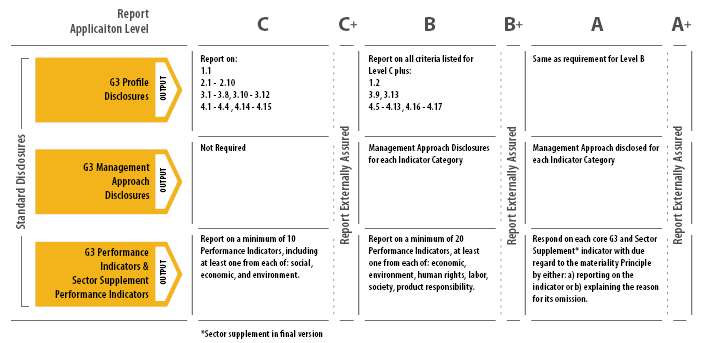
GRI is the grand-daddy of them all. It is huge, containing nearly 80 performance indicators, 40 strategic disclosures and 35 management disclosures. Each of these has up to 20 components each. Phew!
Completing each of these and getting it externally assured would gain a company an A+ rating. Completing a bare minimum and assuring it yourself would gain a C rating.
This is not, therefore, something to be undertaken lightly. Realistically only larger companies who are able to dedicate resources year-in year-out would be able to complete it.
GRI For Large Corporate Websites
Collating data for GRI’s performance indicators will give you statistics, and bags of them. Is it up, is it down, or is it round and round? How do different departments and locations compare … or different companies within a sector … or across industries?
Once a company has completed GRI for a few years it should have enough statistics to be able to talk sensibly about trends, strategies, risks and opportunities. In short, it’s analyst heaven!
But just plonking a thick GRI PDF-report up on a website is only using a small percentage of the information which has gone into it and won’t endear you to analysts. Giving them the raw data will.
Tables can be compiled, graphs drawn and if you’re feeling very adventurous, data streams established. I can feel the analysts getting all excited already!
Transparent Corporate Websites
But why would a corporate go to all this additional effort? In a word: Transparency.
Long before the current recession arrived, sustainability advocates had made transparency a cornerstone of their way of doing business. How can you trust a company’s sustainability, they asked, if it’s opaque about its governance and results?
Now as investors become more and more risk averse, calls for corporate transparency are becoming increasingly loud as companies jostle to appear attractive to potential public and private sector partners.
Using existing sustainability assurance data is a straightforward and cost effective way for a company to demonstrate transparency.
GRI For Small Business Websites
However, just because GRI accreditation is geared towards large companies this doesn’t mean that small, medium and even micro companies (SMMEs) cannot take advantage of its methodology.
This is because GRI is highly modular. Like the project management methodology PRINCE II, it can be used as a pick and mix to pull out the processes which fit your circumstances.
So, as a hypothetical example, the indicators and disclosures on indigenous people are just as accessible to a small importer of African goods as they are to a large multinational mining organisation.
Reading through the GRI disclosures and indicators is highly recommended for any SMME. There is guaranteed to be something directly relevant within it. Formal assurance may not be possible, but publishing how you measure up against individual indicators is bound to differentiate an SMME website.
Is The Future of Sustainability Assurance Online Analysis?
In conclusion, assurance is a great way for companies large and small to demonstrate their commitment to a sustainable future.
It also unearths a wealth of statistics which can be published on a website to bolster a company’s sustainability and its transparency.
Companies large and small should start competing, using raw data to draw and engage investment analysts and business partners alike.
But is it really that simple? Is it as easy as I suggest to publish raw GRI statistics? What about the disclosures side, which is less open to statistical interpretation?
I’m keen to hear your opinions .. please let me know!

Lucy is Editor at Corporate Eye