Recently, the McKinsey Global Institute released a report called The Social Economy: Unlocking Value and Productivity Through Social Technologies. The report explains how social technologies have evolved as well as the opportunities they offer to brands to connect with consumers and companies to boost internal productivity.
The report offers five key pieces of data to describe the power of social technologies today:
- Number of social networking users globally = More than 1.5 billion
- Proportion of total online users who interact with social networks regularly = 80%
- Proportion of companies using social technologies = 70%
- Proportion of companies using social technologies that report some business benefit from them = 90%
- Time each week spent by knowledge workers writing e-mails, searching for information, and collaborating internally = 28 hours
The report also offers five key pieces of data to describe the untapped potential of social technologies for the future:
- Annual value that could be unlocked by social technologies in four sectors = $900 billion – $3 trillion
- Share of consumer spending that could be influenced by social shopping = 33%
- Potential value from better enterprise communication and collaboration compared with other social technology benefits = Double
- Share of companies that derive substantial benefit from social technologies across all stakeholders: customers, employees, and business partners = 3%
- Potential improvement possible in knowledge worker productivity = 20-25%
Furthermore, the report identifies ten ways social technologies can create value for businesses (referred as “value levers”). The tactics are divided into four segments of the value chain: product development, operations and distribution, marketing and sales, and customer service. Two additional enterprise-wide tactics create value by improving productivity across the enterprise. You can see them in the chart from the report below.
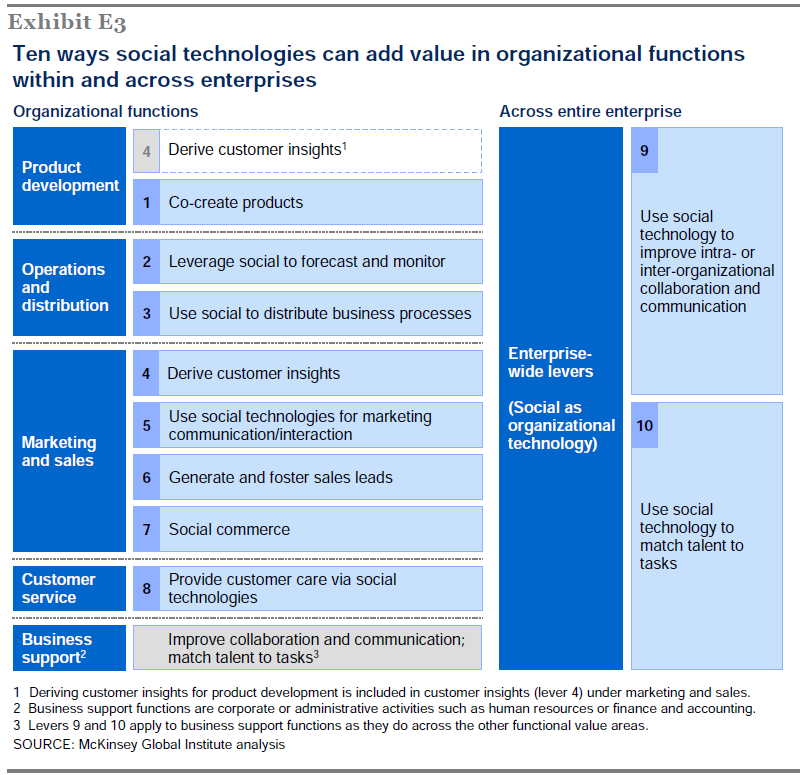
The report concludes that adopting social technologies at the enterprise-level does include risks, but the benefits across the entire value chain far outweigh the potential risks. You can read the full report and get all the details here.
Image: McKinsey Global Institute