In a recent Harvard Business Review post, The Problem of Forced Fun, guest contributor Grant McCracken makes an unexpected and fascinating observation:
When we commandeer the emotional lives of our employees we waste a valuable resource. Left to their own devices, employees represent a wonderful variety of attitudes, interests and activities. They are in fact a very good opportunity for the corporation to survey what is happening “out there” in the world. When we ask them to be outward facing ambassadors for the corporation, we flatten their naturally occurring variety, making it much more difficult for them to serve as inward facing ambassadors for the world.
McCracken, a research affiliate at Convergence Culture Consortium at MIT, is the author of Chief Culture Officer—in which he makes a convincing case that corporations need someone who’s focused on understanding popular culture and anticipating trends. In the HBR post he suggests that using employees to put a happy face on the company has unexpected consequences.
Worth considering: Employee testimonials on the Careers site may seem more authentic if they reflect diverse attitudes and orientations.
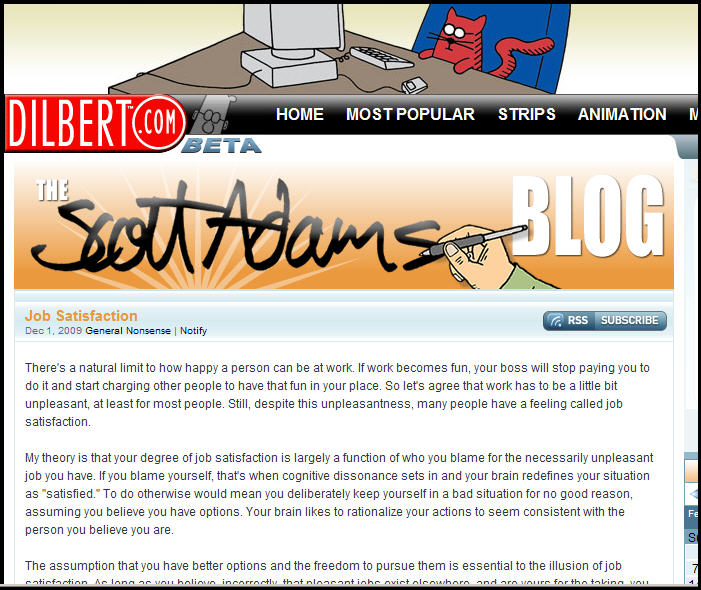
Careening to an entirely different viewpoint, we can look at the Scott Adams theory of job satisfaction, as expounded on Dilbert.com:
My theory is that your degree of job satisfaction is largely a function of who you blame for the necessarily unpleasant job you have. If you blame yourself, that’s when cognitive dissonance sets in and your brain redefines your situation as “satisfied.” To do otherwise would mean you deliberately keep yourself in a bad situation for no good reason, assuming you believe you have options. Your brain likes to rationalize your actions to seem consistent with the person you believe you are.
The post goes on to expound a circuitous method for improving employee satisfaction by convincing workers there are better jobs elsewhere. Worth a read—and don’t skip the comments, which include some surprisingly long, serious responses.
Finally, a few facts about happy/unhappy job-holders. According to the most recent Conference Board report on job satisfaction in the United States, only 45% of those surveyed were satisfied with their jobs . . .
“While one in 10 Americans is now unemployed, their working compatriots of all ages and incomes continue to grow increasingly unhappy,” says Lynn Franco, director of the Consumer Research Center of The Conference Board. “Through both economic boom and bust during the past two decades, our job satisfaction numbers have shown a consistent downward trend.”
Job satisfaction is also at an all-time low in the United Kingdom, according to a recent report from the Chartered Institute of Personnel and Development (CIPD) report.
None of which is surprising, in light of findings from the 2009 Employee Job Satisfaction Survey conducted by the Society for Human Resource Management (SHRM). The top five determiners of employee satisfaction:
- job security
- benefits
- compensation
- opportunities to use skills and abilities
- feeling safe in the work environment
All those factors are in increasingly short supply, so there may not be much room for employers to improve the situation at that level. However—the next five determiners offer a lot more room for positive action:
- relationship with immediate supervisor
- management recognition of employee job performance
- communication between employees and senior management
- the work itself
- autonomy and independence
So . . . maybe Careers sites should focus more on communicating positive messages about the second set of desirables?