The concept of branding for products and services is well known. Employer branding may be the least known type of branding yet is becoming more important to organizations. The reason is changes in workforce demographics. The baby-boomers are retiring and the pool of new recruits is not sufficient to fill the gap. According to an Accenture survey, 60% of CEOs are very concerned about attracting and retaining people. Enter the concept of Employer Branding.
Brett Minchington (The Employer Brand Institute), defines employer branding as “the image of the organization as a ‘great place to work’ in the minds of current employees and key stakeholders in the external market (active and passive candidates, clients, customers and other key stakeholders).”
UK based Business Development Practice Ltd. indicates that ideally, the central idea behind the employer and client brands should be the same. At the very least they need to be consistent (see above graphic). But unlike product or corporate brands, an employer brand is not as visible to its target audience.
This looks like this subject is starting to get complex and involved. It could, and companies could wind up spending lots of money and time to develop their Employer brand. I have a suggestion: you may have seen Fortune magazine’s annual “Best Companies To Work For”. The organization that does the analysis behind the selection process is The Great Place To Work Institute. If you make it to this list you have an effective Employer Brand.
The companies on this list realize that it is the intellectual capital, what is in the minds and hearts of people – rather than the buildings, the tools, the financial capital – that has the power to truly differentiate and grow a business – and beat the competition. Therefore, they do what is needed to attract, grow and keep their people. Benchmarking how these got to the list makes sense.
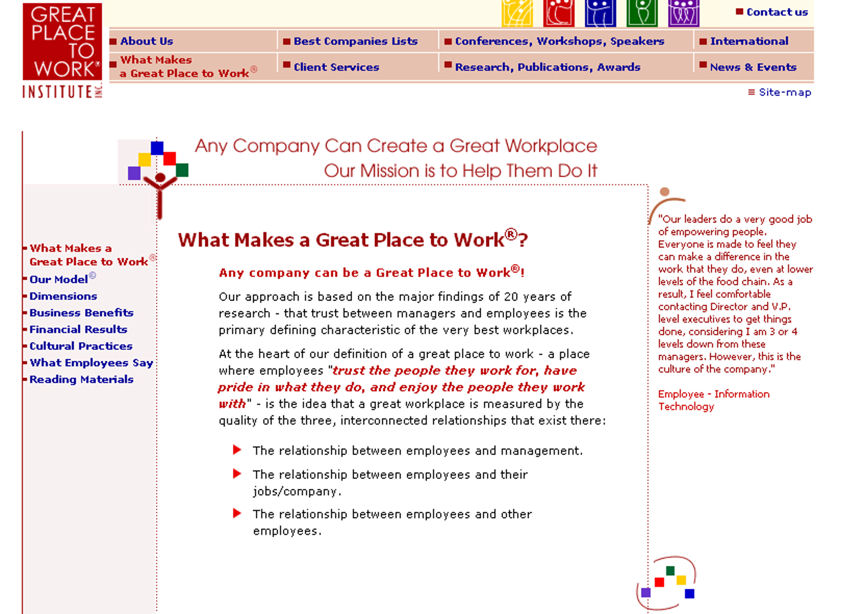
Some suggestions: first look at “Our Model” section. This shows the major dimensions that need to be addressed:
“Trust is the essential ingredient for the primary workplace relationship between the employee and the employer. According to our model, trust is composed of three dimensions: Credibility, Respect, and Fairness. The final two dimensions of the Institute’s model relate to workplace relationships between employees and their jobs/company (Pride), and between the employee and other employees (Camaraderie)”.
This is not quantum physics. It is very straight-forward and not difficult to grasp. Yet too many companies waste money looking for something more esoteric. I particularly like that the Institute says as companies become effective in applying these dimensions the distinction between labour and management fades.
There is more. By treating people well, the companies on the list reap business and financial benefits superior to their peers.
Want to develop an effective Employer Brand? Your first step must be a visit to the The Great Place To Work Institute website.